Latex & Occupational Allergy Market to Reach USD 2.2 Billion
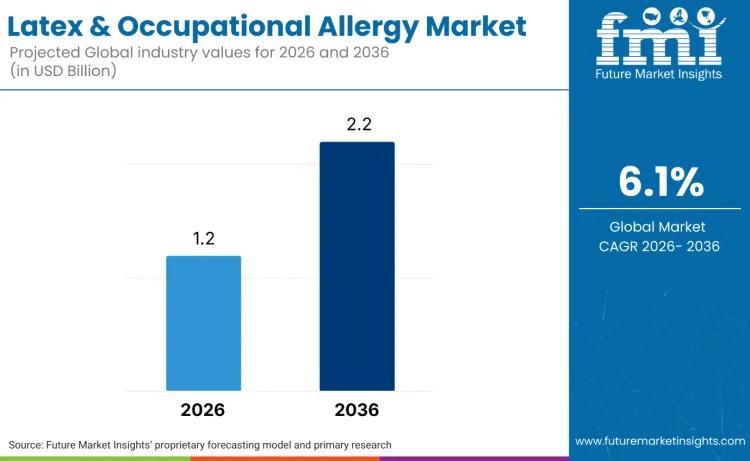
The global latex and occupational allergy market is projected to grow from USD 1.2 billion in 2026 to USD 2.2 billion by 2036, registering a steady compound annual growth rate (CAGR) of 6.1%, according to newly released analysis by Future Market Insights (FMI). This expansion reflects the growing recognition of latex hypersensitivity as a significant occupational health risk, particularly across healthcare, industrial manufacturing, and institutional work environments.
Market growth is being driven by tightening workplace safety regulations, expanded adoption of latex-free alternatives, and rapid advances in diagnostic technologies that enable early identification of latex sensitization. Increasing implementation of comprehensive screening protocols and occupational health surveillance programs is further accelerating demand for evidence-based allergy management solutions.
Read Full Report-https://www.futuremarketinsights.com/reports/latex-and-occupational-allergy-market
Occupational Health Prioritization Accelerates Market Adoption
Latex hypersensitivity remains a persistent concern for healthcare workers, laboratory personnel, and industrial employees exposed to natural rubber latex proteins through gloves, catheters, and medical or industrial equipment. Repeated exposure has been linked to dermatitis, respiratory symptoms, and, in severe cases, anaphylaxis-placing worker safety at the center of occupational health strategies.
As employers prioritize documented risk mitigation and regulatory compliance, the market’s value proposition is shifting toward structured prevention and management rather than reactive treatment. Healthcare systems and industrial organizations are increasingly investing in systematic screening, workplace exposure assessments, and tailored intervention strategies to protect sensitized workers while maintaining operational efficiency.
Under occupational safety frameworks such as OSHA standards, employers are required to furnish appropriate personal protective equipment (PPE) and minimize exposure for workers with known sensitization. These regulatory requirements are reinforcing sustained demand for latex-specific diagnostic testing, environmental monitoring, and latex-free product alternatives.
Advanced Diagnostics and Point-of-Care Platforms Enhance Early Detection
Technological advances in immunoassay platforms and point-of-care diagnostic systems are transforming the identification and management of latex allergy. Modern testing methodologies now incorporate component-resolved diagnostics, enabling clinicians to distinguish between genuine latex allergy and cross-reactivity with other allergens-significantly reducing false-positive results and unnecessary workplace restrictions.
Healthcare institutions are integrating these tools into structured occupational health surveillance programs that combine periodic testing with environmental monitoring. This approach enables early intervention before severe allergic reactions develop, supporting safer workplace environments while preserving productivity.
Leading diagnostic providers continue to invest in platform innovation. Thermo Fisher Scientific’s ImmunoCAPTM and PhadiaTM allergy diagnostic systems remain globally recognized for in-vitro allergy diagnostics, enabling accurate measurement of latex-specific IgE antibodies to identify allergic sensitization.
“Within Thermo Fisher, we see the value of AI in three primary areas-we can use it to enhance our products and services, create a better experience for our customers and help us work more efficiently across our company,” said Ryan Snyder, Senior Vice President and Chief Information Officer, Thermo Fisher Scientific Inc.
Latex-Specific Diagnostic Testing Leads Market by Product Type
Latex-specific diagnostic testing represents the largest product segment, accounting for 28.5% of total market revenue. Accurate identification of latex sensitization remains the clinical foundation for all subsequent workplace modifications and alternative product decisions.
Demand for targeted testing continues to rise across hospitals, dental clinics, laboratories, and manufacturing environments. Symptoms often resemble dermatitis or asthma, making definitive diagnosis essential for guiding avoidance strategies, accommodation planning, and safer product substitution. Preoperative screening is also increasingly utilized to reduce perioperative anaphylaxis risks linked to gloves, catheters, and surgical drains.
Occupational health programs rely on testing outcomes for compliance documentation, accommodation planning, and surveillance reporting-reinforcing the central role of diagnostics in market expansion.
Healthcare Facilities Dominate Application Settings
Healthcare facilities represent the largest application segment, capturing 38.2% of total market share, reflecting the high concentration of latex exposure risks in clinical environments. Medical personnel routinely encounter latex through gloves, catheters, and surgical equipment, necessitating specialized protocols that balance infection control with allergy prevention.
Surgical and perioperative environments account for significant service utilization due to the critical nature of allergic reactions during procedures. These settings require comprehensive pre-procedure screening, latex-free operating room protocols, and emergency management capabilities designed specifically for perioperative allergic emergencies.
Industrial manufacturing also represents a growing application segment, as repeated exposure to natural rubber materials in production processes increases sensitization risks. These environments require specialized assessment protocols tailored to distinct exposure patterns and workplace conditions.
Corporate Portfolio Shifts Accelerate Latex-Free Transitions
Major healthcare suppliers are restructuring PPE portfolios to reduce regulatory exposure and refocus on allergy-safe consumables. Companies such as Ansell Limited have expanded latex-free surgical and examination glove lines, positioning nitrile and neoprene as default options across hospital procurement programs.
This portfolio shift allows manufacturers to concentrate investment on hypoallergenic materials, barrier performance, and cost-optimized synthetic polymers. Healthcare providers are simultaneously accelerating system-wide latex phase-outs across operating rooms, diagnostics, and frontline care environments.
Strong Growth Outlook Across Emerging and Developed Markets
Global market expansion reflects increasing recognition of workplace hypersensitivity management as an essential component of modern occupational health programs. FMI projects particularly strong growth across emerging economies and regulated healthcare markets:
China: 8.2% CAGR
India: 7.8% CAGR
Brazil: 6.5% CAGR
USA: 6.3% CAGR
Germany: 5.1% CAGR
In India, growing emphasis on healthcare worker protection and expanding medical infrastructure under national health initiatives are supporting adoption of evidence-based occupational health management. India’s role as a major medical tourism destination further increases demand for internationally recognized allergy management protocols that ensure patient and staff safety.
China’s rapid healthcare infrastructure expansion and adoption of international workplace safety standards are also driving demand for professional allergy assessment services and latex-free alternatives.
Subscribe for Year-Round Insights → Stay ahead with quarterly and annual data updates: https://www.futuremarketinsights.com/reports/brochure/rep-gb-31828
Request for Sample Report | Customize Report |purchase Full Report:https://www.futuremarketinsights.com/reports/sample/rep-gb-31828
Competitive Landscape Anchored by Diagnostics and PPE Leaders
The competitive landscape is defined by global diagnostics firms and healthcare product manufacturers with broad portfolios and international reach. Key players include:
Thermo Fisher Scientific Inc.
Siemens Healthineers AG
Abbott Laboratories
Roche Diagnostics International Ltd.
Bio-Rad Laboratories, Inc.
Ansell Limited
Medline Industries, Inc.
Cardinal Health, Inc.
3M Company
Honeywell International Inc.
These companies focus on expanding diagnostic platforms, enhancing assay sensitivity, strengthening regulatory compliance, and advancing latex-free material innovation to capture growing demand.
Market Outlook: From Testing to Integrated Occupational Health Platforms
FMI analysts expect the latex and occupational allergy market to evolve from basic allergy testing toward comprehensive occupational health management platforms integrating predictive analytics, personalized safety protocols, and digital compliance reporting. As healthcare systems and industrial facilities prioritize prevention effectiveness, diagnostic accuracy, and regulatory adherence, demand for sophisticated testing platforms and expert consultation services will continue to rise.
Explore More Related Studies Published by FMI Research:
Hydrocephalus Shunt Market: https://www.futuremarketinsights.com/reports/hydrocephalus-shunt-market
Endoscopic Closure Systems Market: https://www.futuremarketinsights.com/reports/endoscopic-closure-systems-market
Mammalian Transient Protein Expression Market: https://www.futuremarketinsights.com/reports/mammalian-transient-protein-expression-market
Home Sleep Apnea Testing Market: https://www.futuremarketinsights.com/reports/home-sleep-apnea-testing-market
Lacrimal Devices Market: https://www.futuremarketinsights.com/reports/lacrimal-devices-market
Why FMI: Decisions that Change Outcomes- https://www.futuremarketinsights.com/why-fmi
Have a specific Requirements and Need Assistant on Report Pricing or Limited Budget please contact us – [email protected]
Contact Us:
Future Market Insights Inc.
Christiana Corporate, 200 Continental Drive,
Suite 401, Newark, Delaware – 19713, USA
T: +1-347-918-3531
Website: https://www.futuremarketinsights.com
LinkedIn| Twitter| Blogs | YouTube
About Future Market Insights (FMI)
Future Market Insights, Inc. (FMI) is an ESOMAR-certified, ISO 9001:2015 market research and consulting organization, trusted by Fortune 500 clients and global enterprises. With operations in the U.S., UK, India, and Dubai, FMI provides data-backed insights and strategic intelligence across 30+ industries and 1200 markets worldwide.
This release was published on openPR.
link