How Aderholt will oversee spending for education, health departments
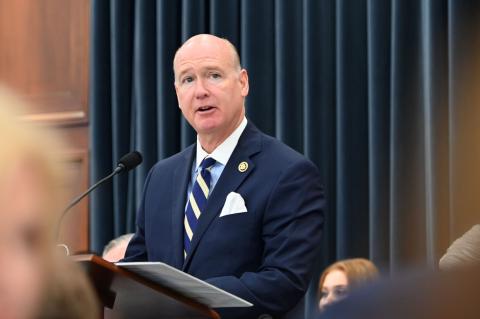
WASHINGTON — When Congress returns after the August recess, it will be primetime for Rep. Robert Aderholt as his appropriations subcommittee considers its spending bill for the labor, health and education departments, which the Trump administration has targeted for funding cuts.
Aderholt, who has chaired the House Appropriations Labor, Health and Human Services and Education subcommittee since 2023, previewed that the spending bill for fiscal year 2026 will include some cuts but will also ensure the departments it funds “can still do their mission.” The text of the House spending bill has yet to be released and is still being finalized.
“What we’re trying to do is look for waste, fraud and abuse, and where there’s something that is duplicated in some other agency or department,” Aderholt, R-Haleyville, said in an interview with Alabama Daily News before the recess. “So the taxpayer is not funding one agency to do the same thing that another agency does.”
The subcommittee is expected to mark up the spending bill in the first week of September when lawmakers return to Washington.
The House’s version of the Labor-HHS-Education spending bill sets a topline of about $184.5 billion. That’s about $13 billion less than the Senate’s legislation, which allocates about $197 billion in discretionary spending for the Labor, Education, and Health departments. The House has mostly appropriated less money than the Senate in its bills this year, which more closely aligns with the White House’s goal to reduce spending. This all could tee up a clash as the funding battle nears the end of September.
Since the House Appropriations Committee has yet to take up the Labor-HHS-Education spending bill, and the House has only passed one appropriations bill on the floor so far this year, the next fiscal year is likely to start with a continuing resolution.
“I expect that we will probably do some kind of (continuing resolution) at some point, because we only have September when we come back from August and the new fiscal year starts Oct. 1,” Aderholt told ADN.
However, the continuing resolution could be short-term for a month or two while the two chambers work to pass all 12 appropriations bills to fund the government, Aderholt said.
The labor-HHS-education subcommittee also oversees funding for public media. Aderholt told Alabama Daily News before the recess that it was possible the bill could include funding for local public television stations after Congress clawed back $1.1 billion from the Corporation for Public Broadcasting. But that looks to be in jeopardy.
The Senate’s version of the bill, which passed out of committee last week, does not include funding for the Corporation for Public Broadcasting, which subsequently announced it was shutting down.
“We know there’s a lot of support for a lot of these public television stations across the country, and we’re trying to see what we can do to try to help them,” Aderholt said.
The congressman said he wasn’t interested in providing funding for National Public Radio.
Aderholt’s subcommittee has jurisdiction over the National Institutes of Health funding, where the Trump administration has cancelled grants and frozen funds. It’s not clear yet how the House plans to fund the NIH, but the Senate Appropriations Committee recently rebuked cuts to the health research agency, increasing its funding by $400 million for the next fiscal year.
The labor-HHS bill represents the largest non-defense spending sector of the Appropriations Committee.
One Big Beautiful Bill Act
Aderholt is a staunch supporter of President Donald Trump’s tax breaks and spending cuts package that’s now law. He touted the tax cuts in the bill during an interview with ADN and highlighted how the legislation included the adoption tax credit, which Aderholt championed.
“It’s up to $5,000 and that’s significant, and it’s a tax credit, as opposed to being just a deduction… and especially for households that don’t earn a large income, that can be pretty significant in helping toward adoption,” he told ADN.
As co-chair of the Congressional Adoption Caucus, Aderholt said the inclusion of the provision in the bill marked a positive step in supporting families who want to adopt.
The Alabama Republican argued the massive bill “helps everybody,” including working Americans. While an analysis from Yale Budget Lab shows that the tax cuts, when taken into account with the spending cuts on social safety net programs, will benefit high earners more than low earners.
Alabama delegation’s work
As the dean of Alabama’s congressional delegation, Aderholt looked back on the first seven months of the 119th Congress and how the state’s delegation has continued to have a collegial working relationship with one another.
The Alabama members meet monthly for lunch.
“The delegation as a whole works very seamlessly together, and we’re each on different committees,” Aderholt told ADN.
It’s not a given that an entire state’s delegation gets along well, Aderholt said.
“We compare notes and try to make sure that what’s good for the southern part of the state is good for the northern part, and vice versa and everything in between,” he said.
link