


In New Hampshire, the second oldest state, plenty of older adults like to stay fit and active. They enjoy the outdoors year-round, compete in senior leagues, and start a new sport in retirement or reboot the one they loved when they were younger.
That makes for lots of sports medicine patients.
According to the U.S. Census, since the 1990s, the number of people age 65 and up grew faster than the number of people under 65, and faster than the total U.S. population. By 2040, projections say there could be 80.8 million people in the U.S. age 65 and older, almost twice the count in 2012.
“We’re an aging country. People are staying active much later in life. We see injuries and wear and tear in the middle-age and aging population,” said Dr. Daniel Bouvier, an orthopedic surgeon at New Hampshire Orthopaedic Center in Bedford. “People are playing soccer and skiing hard until their late 50s and 60s. Some older patients play men’s soccer at 60.”
“People are staying very active in sports that you wouldn’t (normally) see in their 60s to 80s, and we’re seeing sport-related injuries in these patients,” said Dr. Brendan Higgins, an orthopedic surgeon at Concord Orthopaedics, who performs arthroscopic surgery on shoulders, knees and hips.


Dr. Brendan Higgins, an orthopedic surgeon and sports medicine specialist, demonstrates an exam of a patient’s left shoulder.
Rotator-cuff repairs in people ages 55 to 70-plus account for most of the shoulder surgeries that Higgins does, usually because of a fall or tissue degeneration.
Like his colleagues, he performs surgery to reconstruct the ACL, the anterior cruciate ligament, a critical connector in the knee. He also repairs the meniscus, the cartilage that acts as the knee’s shock absorber.
Demand for those services is climbing.
According to a study presented at the 2024 meeting of the American Academy of Orthopaedic Surgeons, sports injuries in Americans 65 and older increased by more than 67% between 2012 and 2021 and are projected to jump by 123% between 2021 and 2040, as people live longer and stay active in their later years.
From 2012 to 2021, nationwide, there were an estimated 772,973 sports-related injuries in seniors, at an average age 73. Almost half occurred in women.
In 2012, 51% of senior sports injuries were sprains or strains and 49% were fractures. By 2021, 57.3% were fractures and 32% were strains or sprains.
The pickleball factor
Researchers believe older athletes are getting injured more frequently because they’re participating in more sports, or in sports where they’re more likely to get hurt.
“In practice, we are seeing adults in their 80s and 90s participating in activities that weren’t previously of interest to them, such as pickleball,” said Dr. Jay Zaifman, a study author and an orthopedic surgery resident at NYU Grossman School of Medicine.
Pickleball, America’s fastest-growing sport, was invented in 1965 and exploded in popularity after 2000, offering something fun, easy to learn and accessible across the age span. It’s a common cause of injuries that older people don’t anticipate, such as broken wrists from falling and assorted other problems that come from twisting, lunging and swinging the racket.
Many older players have switched to pickleball from tennis or other racket sports. Others are first-timers who have been sitting on the bench or mostly stationary at home, whose muscles aren’t especially nimble, elastic or primed to perform.
“If you were playing tennis the week before, it’s one thing,” said Bouvier. “But if you’re over 70 and haven’t been very active, starting a pivoting and twisting sport” can be very demanding.
When told to take a break or find a different activity, Bouvier said, “I’ve had patients in tears because they like it so much.”
“With any racket sport, you’re going to see more shoulder injuries, whether tendinitis, rotator cuff tears or aggravated conditions such as arthritis,” said Dr. Neal Goldenberg, chief of sports medicine at Cheshire Medical Center in Keene.
Goldenberg said that in a single day he sees patients that are 9 or 10 up to seniors in their 60s and 70s. “I think that speaks to people living longer, staying active longer and doing the things they love to do longer.” He says his job is to keep them that way.
Tender tendons
Fractures in the 60s to 80s age group come mainly from tripping and falling, said Higgins. Meniscus tears in knees can arise from pivoting and twisting.
“We see more meniscus tears as we get older,” also from kneeling or squatting, said Goldenberg. Young college athletes usually require surgery, he said, while older patients with underlying osteoarthritis may be able to reduce pain and increase activity without it.
Most tendon breaks occur in rotator cuffs, the Achilles tendon in the heel, or in the elbow’s distal biceps tendon, said Bouvier. Acute tendon injuries have a limited window in which they can be fixed, he said.
“Attritional” tendon tears that result from wear and tear can be repaired most of time through arthroscopic surgery, which reattaches the tendon to bone, he added.
“We hope the patient’s biology and tendon quality are enough to heal it there,” Bouvier said.
“Some people, now in their 70s or 80s, have had the problem for decades, and have pain from rotator cuff arthritis, which is not repairable.”
Matters of weight
Weight-bearing exercises are important for post-menopausal women to prevent osteoporosis, or bone density loss, which puts them at greater risks of breaks and fractures.
Sometimes the doctor’s advice is simply to keep moving, or to carefully start moving more.
The same applies to patients with obesity, including seniors who many not be in an exercise program.
Orthopedists and sports medicine doctors report an uptick in patients with obesity, which accelerates the disease process in aging bodies. Osteoarthritis is occurring earlier because of weight bearing and the strain on joints.
“Falls are creating significant trauma because of excess weight and obesity,” said Goldenberg.
Many have problems with their ankles and feet.
For overweight people with knee pain, exercise can be just what the doctor ordered, and not just to burn calories.
“Long term, exercise helps with pain relief and increases pain tolerance,” said Goldenberg. “Motion is good for tissue healing. Doing the right exercise can provide the right environment.”
It can be painful at first, but exercise improves range of motion and decreases muscle scarring, Goldenberg said.
“Almost everyone feels like they go for walks. But sometimes it’s better to switch to a bike or pool,” said Bouvier, whose job includes redirecting patients to something safer for them.
Following through with physical therapy is key.
“In sports medicine, physical therapy is hugely important to get better without surgery, and post-operatively, to guide patients and get their joints moving again,” Bouvier said. “The education and guidance (physical therapists) bring is immensely important.
“I worry about the patient who’s not in physical therapy and is using their pain as a guide. A lot of time we’re sending them to PT to get a home program created.” When they exit physical therapy, maintenance exercises are critical.
Preventing injuries
Dr. Kristine Stupay, an orthopedic surgeon at Concord Orthopaedics, specializes in foot and ankle repairs. Most of her patients participate in recreational walking, running, cycling, hiking, skiing, yoga or pickleball. Around 10% are competitive athletes, including older adults. She said injury prevention is a mission.


Dr. Kristine Stupay, an orthopedic surgeon who specializes in foot and ankle treatment at Concord Orthopaedics, examines an athlete’s ankle strength after an inversion injury.
To avoid Achilles tendon tears, Stupay recommends warming up before activity and adopting a regular stretching program to improve hamstring, calf and Achilles flexibility.
Ankle fractures and breaks are difficult to prevent, she said, because they usually result from accidental twists or falls. “So, all I can say is: Phone down, eyes up, people!” Stupay said by email.
Ankle sprains can be avoided by improving hip, core and ankle strength; balance; and by “proprioceptive” retraining that targets the brain’s connection to the body, “which can significantly affect your ankle and foot responsiveness, reliability and overall function,” Stupay said.
Most ankle and foot conditions that are not related to trauma, such as tendinitis and instability, can benefit from structured physical therapy focused on ankle strength, balance, mobility and proprioceptive retraining, she said.
As an authority on feet and ankles, she recommends preventive exercises that target core strength in the lower back, hip abductors, deep core and pelvic floor as well as calf and Achilles stretches.
These exercises apply broadly to recreational sports and can support fitness in daily life.
Treating yourself
When you get hurt, “The age old ‘RICE’ is the first step in almost every sport-related injury,” she said. “This means ‘Rest, Ice, Compression, Elevation,’” which help prevent and reduce swelling and inflammation, which affect pain and recovery time.
Bracing is used to restrict movement and support the injured area during the healing process. Anti-inflammatory medications such as Advil, Motrin, ibuprofen and Aleve “can decrease pain and swelling and be used liberally in the early days,” Stupay said.
Worldwide records show that declines in sports performance accelerate after age 70, especially in swimming, long-distance running and sprinting.
“I think a lot of patients are hesitant to see the doctor,” said Goldenberg at Cheshire Medical Center, which serves a sizeable number of active older patients. “Our goal is to get them to do the things they want to do safely, pain-free and long-term.”


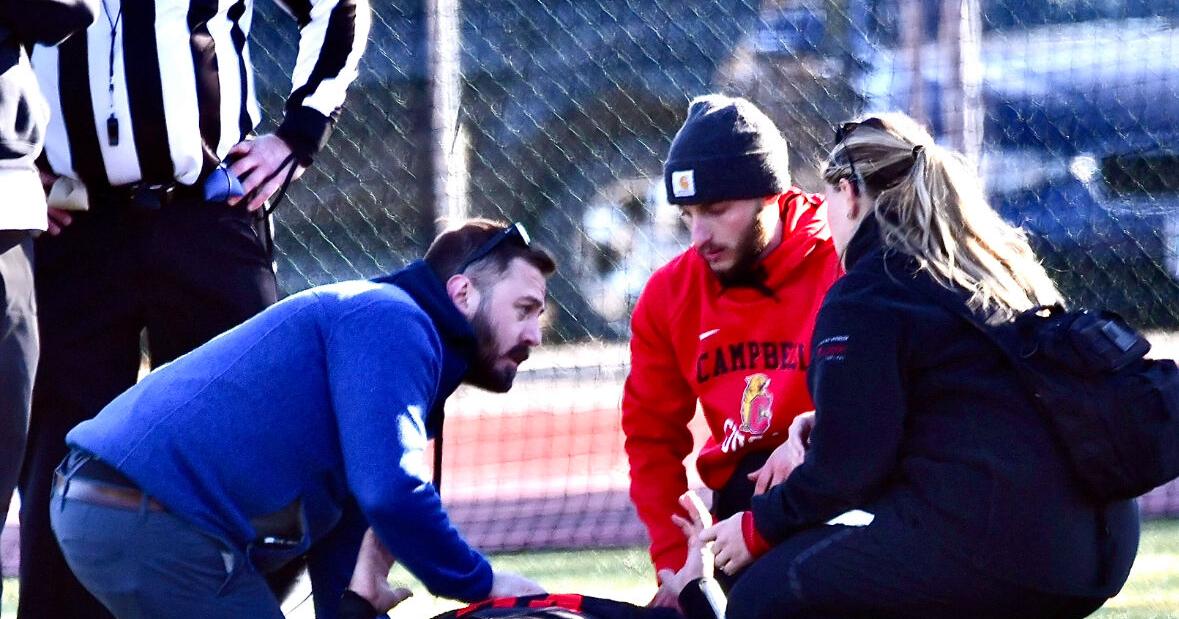
Dr. Tom Fortney, an orthopedic surgeon at New Hampshire Orthopaedic Center, tends to an injured player during a football game between Trinity and Campbell high schools in 2023. Sports injuries aren’t limited to younger athletes, Fortney says.
Dr. Tom Fortney
Sports medicine applies “more broadly than most people realize,” said Dr. Tom Fortney, an orthopedic surgeon and shoulder specialist at New Hampshire Orthopaedic Center in Bedford.
“I think the instinct is it’s for younger athletes, but these injuries occur in all ages. People are playing recreational sports more and more at older ages. We’re here to help them recover from injuries so they can stay physically fit and remain active longer.”
“It doesn’t have to be sports-related injury,” said Dr. David Goumas, an orthopaedic surgeon and sports medicine specialist at New Hampshire Medical Center. “As we get older, we have more issues with arthritis and tendinitis that are exacerbated with sports or activity.”
Goumas recently gave a community lecture on pickleball.
“So many patients are involved in pickleball, including 70-year-old ladies with headbands who had never had an opportunity to play sports before.” Pickleball “is very competitive.” Sometimes, to get them to slow down so they don’t get hurt, “I have to say, ‘Look, your body is still 70.’”
link