


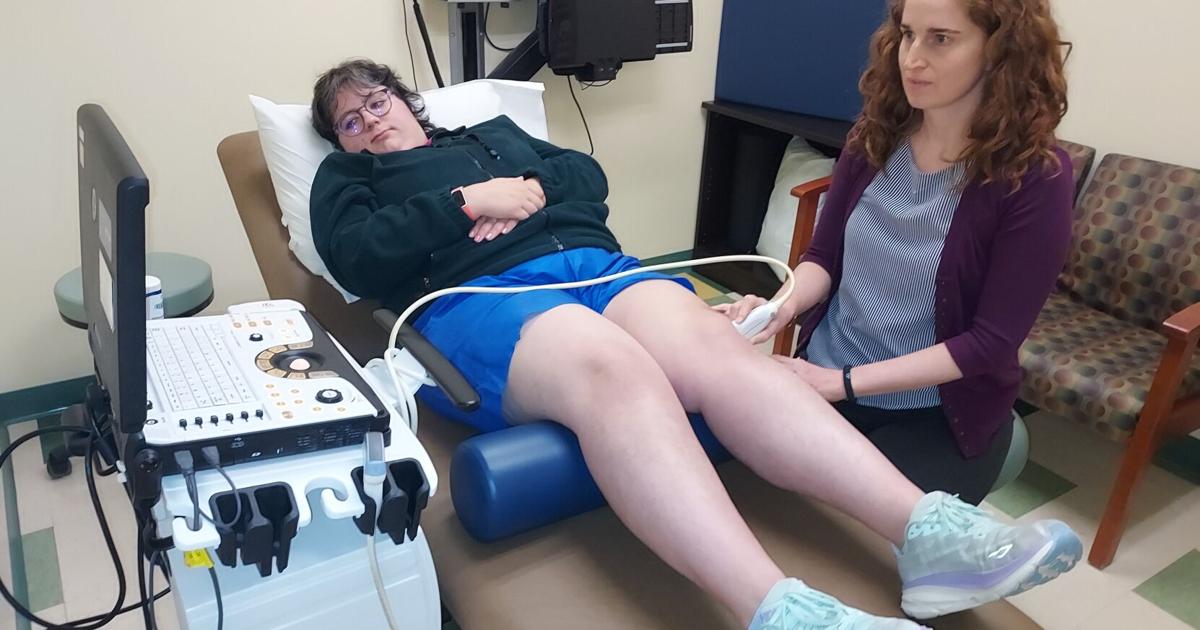
Sports medicine is not just for athletes, or amateurs who consider sports a part of life.
It’s for gardeners, laborers, tradespeople, movers, musicians, postal and delivery workers, custodians, cleaners, active moms and dads, hobbyists and weekend warriors who plunge into sports and outdoor recreation on vacations and weekends — anyone who experiences pain from a soft-tissue injury, sprain, strain, repetitive movement or overuse. That includes athletes — kids through seniors.
Sports medicine doctors primarily treat muscles, ligaments, tendons and joints, usually without surgery. Pulled hamstrings. Rolled ankles. Dislocated shoulders.
Orthopedic surgeons, who operate on bones, tendons and joints, can sub-specialize in sports medicine. So can primary care and family doctors who complete fellowships in nonsurgical sports medicine. The landscape of practitioners is wide-ranging, and so are the injuries that come from physical activity, not just sports.
“There’s a huge misconception,” said Dr. Erika Sadeghi, a nonsurgical sports medicine physician at Elliot Orthopaedic Surgery Specialists in Manchester. “People think, ‘I can’t see a sports medicine doctor. I’m not an athlete.’ There’s so much more to it.”


Dr. Erika Sadeghi of Elliot Othopedic Surgery Specialists in an exam room at her Manchester office on Aug. 21.
“I don’t think sports medicine doctors are well understood,” said Dr. Elana Bannerman, a family physician and sports medicine specialist at Southern New Hampshire Health’s outpatient clinic in Hudson, who says she treats many more nonathletes than athletes.
‘Night pain is the red flag’
“It’s not just for competitive sports in high school,” said Dr. David Goumas, an orthopedic surgeon at New Hampshire Orthopaedic Center in Bedford with advanced training in sports medicine. “Most of my patients are weekend warriors who come in with a knee problem or shoulder problem. Most of the time it’s for conservative treatment” that doesn’t include surgery.
“As we get older, we have more issues with arthritis and tendinitis,” conditions that worsen with age and overuse. “You could be gardening. Anything that’s repetitive lifting or a constant motion. You take Aleve, put ice on it and it doesn’t get better. Two, three, four weeks later if it’s still a problem, you need to see someone. Night pain is the red flag,” said Goumas.
Dr. Douglas Goumas speaks with a reporter at New Hampshire Orthopaedic Center in Bedford.
Think of a persistent ache, pain when you’re still or trying to sleep or a sharp, sudden pain with movement — not from a bone break or fracture, which doctors can detect on an X-ray, but pain that originates in the embedded tissues that power, support and move our bones through daily activities.
Years to life, life to years
Sadeghi, a family doctor who completed a fellowship in sports medicine, treats chronic arthritis pain in patients who don’t need, want or aren’t clinically ready for joint replacements. She treats osteoarthritis, which is inflammation, as opposed to rheumatoid arthritis, which is autoimmune in nature and the specialty of rheumatologists.
“Part of my role is treating nonathletes,” pediatrics to geriatrics, anyone who would benefit from nonsurgical therapies to combat pain and improve movement, Sadeghi said. “We want to add years to your life, and life to your years. That’s what movement does.”
Sadeghi counsels patients on how to live an active lifestyle, varying their sports and activities to avoid overtaxing or traumatizing a particular part of the muscular-skeletal system.
“I try to take the gentle approach,” while mindful of their goals, physical condition and ability. “I start the conversation and build from there.”
Sometimes she counsels patients on how to increase movement to decrease obesity. She uses ultrasound to pinpoint problems that may only be visible when joints and tissues are moving. MRIs (magnetic resonance imaging) illuminate soft tissue at rest. Sadeghi uses therapeutic injections, steered by ultrasound, to combat pain and regenerate damaged tissue.
She also educates patients.
“Is your goal to be healthy or cross a marathon finish line? You need to individualize care for the patient,” said Sadeghi, who defines sports medicine as the medical management of injuries, acute and chronic. “It’s about finding out who they are, what their goals are and meeting them there.”
“Strength and conditioning cross-training are often overlooked,” especially by nonathletes, she said. “When we think of sports, we think of football and baseball players. We are all these athletes within ourselves.” The key is to “find something you love to do to keep you going.”
As a nonsurgical sports medicine doctor, Sadeghi often sees patients who have tried everything else.
PT as a partner
Bannerman, a family physician who completed a fellowship year for advanced training in sports medicine, sees a broad range of people and problems at her clinic in Hudson. Her office contains poster-size lists of exercises, but it’s never one size fits all, she said.
Physical therapy is her partner in healing stubborn soft tissues.
Patients often ask, “Can’t you just give me a set of exercises?” She quickly responds, “You need physical therapy. You need someone trained to watch and adjust. You need them to analyze your movement patterns. Sometimes they change your movements by only a millimeter.”
“Just an overall change in habits, body movements and patterns over the day” can be the game-changer, Bannerman said.
Physical therapists can diagnose problems, pinpoint weakness and imbalance, and deliver focused treatment.
“My job is to get them there and they have a good experience. They’re the real work horses. They make the change.”
As a sports medicine specialist, Bannerman is frequently a pivotal agent.
“I see everything,” she said. Overuse injuries and trauma. Chronic strains, tendinitis, shin splints, stress fractures. Ankle sprains and damaged knee ligaments. Chronic muscular-skeletal pain such as osteoarthritis.
“I see more nonathletes than athletes.”
Some of her patients are casually athletic. Others are on high school or college sports teams. A fraction are professional athletes. Some aren’t the least bit athletic, but their jobs, chores and pastimes involve repetitive motion.
“Tendons,” the bands that connect muscle to bone, “can have wear and tear and they just don’t heal,” she said.
Sports medicine procedures can poke miniscule holes in tendons to create blood flow, which the body interprets as a green light to start healing. Others can open the spaces around impacted nerves.
Exercises that matter
If Bannerman could recommend an exercise approach that works for everyone, it would be “do what you like, what makes you happy and feel good,” she said.
She said most of us need upper-back exercises that engage the muscles between the shoulders to counteract the weakness that can comes from slouching over laptops and keyboards. Gluteal (posterior) exercises can stabilize us while we walk. Core strengthening exercises such as bridges and “dead bugs” (lying on your back, alternating and extending your arms and legs like a bug on its back) can shore up the trunk that keeps your body aligned and more resistant to injury.
“During COVID, people became more active or less active and I saw people for both of those reasons,” said Bannerman, who took up sports medicine when she discovered that most of the complaints family physicians see are rooted in muscular-skeletal problems. Her patients range in age from 8 to 100.
“It’s wonderful to keep people active who want to be active. It’s wonderful to give people techniques to keep that going. As we get older, our joints and tendons wear out and we lose muscle mass,” she said.
Get some advice
Before plunging into a new sport, Bannerman advises her patients to take a lesson or work with a coach or trainer.
Personal trainers can help newcomers develop and carry out a set of exercises and can troubleshoot problem areas.
A physical therapist focuses on movement patterns and therapeutic exercise while “a trainer is more about improving performance,” she said.
It’s important to incorporate strength and stability while walking for exercise.
Because exercise machines at the gym move the muscles in a pre-determined direction, Bannerman recommends dumbbells and kettle bells over training machines and barbells. “Free weights are better” to increase strength across a full range of motion, she explained.
Goumas at New Hampshire Orthopaedic Center in Bedford, an orthopedic surgeon with a subspecialty in sports medicine, estimates that he’s performed 5,000 rotator cuff repairs in shoulders in the last 25 years, about 200 annually.
The rotator cuff is a common weak area for many adults. The main cause of problems are repetitive activities, mostly overhead, he said.
“You can be painting the house, working in the garage, working outside doing landscaping. As we get older, the rotator cuff tendon gets weaker, it degenerates.” That, combined with repetitive overhead activity produces problems for both males and females.
When it comes to getting injury care, “It’s so important for patients to advocate for themselves,” said Goumas. “Pain is difficult for patients to nail down. Also for providers. They end up giving diagnostic injects to sort it out.
“What is the intensity of the pain? What is the quality of the pain? Was it an injury or did it come on without trauma? When pain affects quality of life, sleep and independence, it’s time to seek help.”
link