


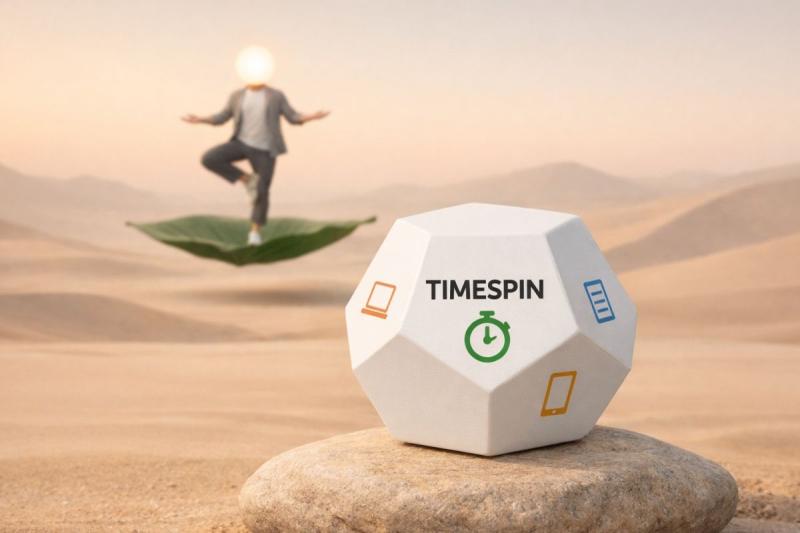
Workplace health management with TimeSpin ( (C) TimeSpin GmbH)
Germany / [Bremen] – [January 9, 2026] The modern working world faces a paradox: while digital tools are supposed to increase efficiency, they often lead to cognitive overload. According to recent studies, mental stress in the workplace is now the main reason for absenteeism. With its haptic time tracking cube, the innovative tech company TimeSpin (R) presents a solution that goes far beyond conventional time tracking. It integrates itself as an active control element into all three pillars of occupational health management (BGM) and creates a new level of transparency and employee protection.
Pillar 1: Occupational safety – prevention through real data Legal occupational safety regulations require employers to assess hazards and comply with working time laws. Here, TimeSpin (R) offers more than mere compliance. The TimeSpin approach: With real-time recording accurate to the minute, the system makes overtime and missed breaks immediately visible, rather than only at the end of the month.
Benefit: A project manager in a marketing agency can immediately see in the dashboard when a team member has been working on a “deep work” task for six hours without a break. The system can also be used as an early warning system for fatigue/overwork and helps to ensure compliance with the Working Hours Act (ArbZG) effortlessly and in a legally compliant manner. Pillar 2: Workplace health promotion (WHP) – focus instead of multitasking WHP aims to strengthen resources and reduce stress. The greatest stress today: the constant fragmentation of attention. The TimeSpin approach: The dodecahedron principle of TimeSpin (R) promotes single-tasking. When you turn the cube, you commit yourself haptically to a task.
Benefit: In IT development, this reduces the so-called “context switching penalty” – the stress that arises when jumping between different tasks. Employees report significantly lower stress levels because the cube serves as a physical anchor for concentration. The result is a measurable increase in work quality while reducing mental exhaustion.
Pillar 3: Workplace integration management (BEM) – a structured return to work After a long period of illness, gradual reintegration is crucial. Many processes fail here due to a lack of transparency about the actual workload. The TimeSpin approach: TimeSpin (R) enables a detailed analysis of activities during the reintegration phase.
Benefit: An employee returning after burnout can work with their manager to determine which tasks (sides of the cube) are particularly stressful. The evaluation provides objective evidence of whether stress limits are being adhered to or whether the task profile needs to be adjusted. This creates trust and security on both sides.
Transparency as a currency of trust A key problem with many occupational health management measures is a lack of acceptance. TimeSpin (R) solves this through the principle of personal responsibility. Data sovereignty lies with the user, while the company receives aggregated insights for workflow optimization.
“We have to stop seeing time tracking as a control instrument. In a modern occupational health management system, it is a diagnostic tool for corporate health,” says Dennis Urban, TimeSpin expert. “TimeSpin (R) reveals where energy is being lost and where we need to create space for recovery.”
TimesSpin GmbH
Bremen 28237
Germany
https://timespin.net/
04215656130
durban@timespin.net
TimeSpin GmbH, based in Bremen, was founded in December 2022. After the coronavirus pandemic and the massive increase in remote and hybrid working, it became clear that old time tracking methods were no longer sufficient. Oliver Otto, founder of TimeSpin, had a vision of making time tangible–because time is the most valuable but least understood resource.
His idea: a product that combines productivity, focus, and health while creating an intuitive experience. TimeSpin is the result of this vision–a bridge between analog experience and digital efficiency.
This release was published on openPR.
link