


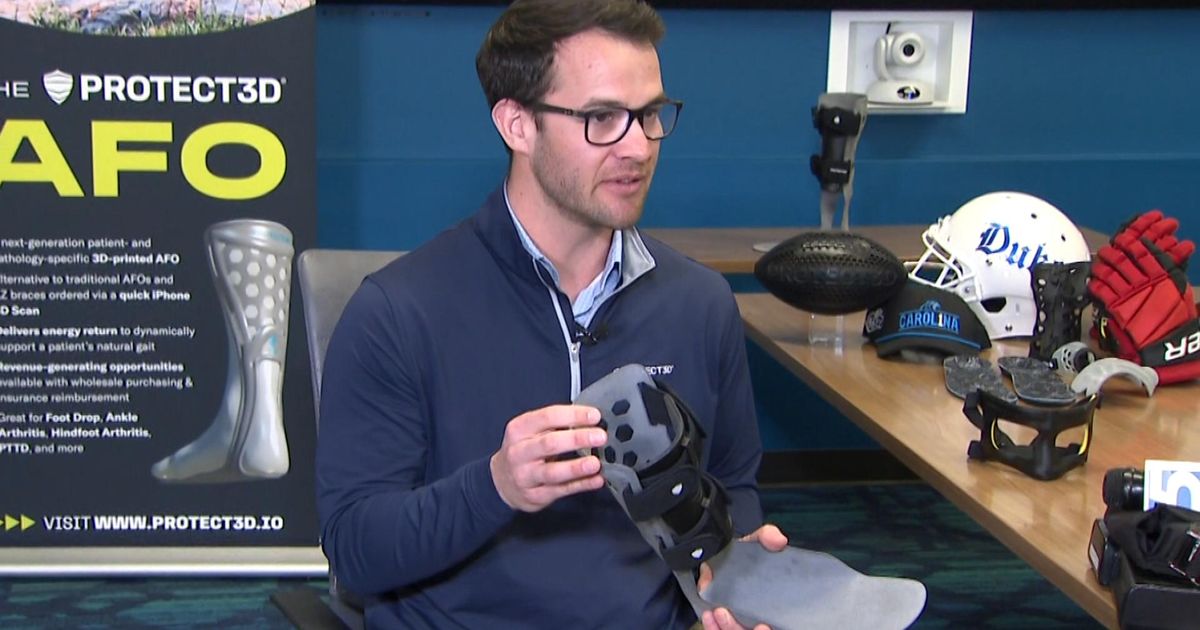
In a Durham facility along West Main Street, the quiet hum of 3D printers is the soundtrack of homegrown innovation redefining sports medicine.
Inside PROTECT3D’s headquarters, rows of machines build custom athletic braces using thousands of layers of material.
Each one is unique in size, shape and purpose.
The company officially launched seven years ago, but the idea was born even earlier – inside a Duke University dorm room.
CEO Kevin Gehsmann told WRAL News that he and co-founder Clark Bulleit were student-athletes on Duke’s football team.
Their goal was simple: Keep their teammate in the game.
“In high-level athletics, inches make the biggest difference,” Gehsmann said. “Anything that slightly intrudes on your peak performance is really inhibiting and drives decreasing confidence.”
PROTECT3D’s unique software uses a phone or a tablet to capture a scan of an athlete’s injury in under a minute. Those digital details are then used to create a custom 3D-printed brace.
The first prototype was to help a defensive back heal from a broken arm. The second was for former Duke quarterback Daniel Jones’ fractured collarbone. Next came a pad for a player’s AC separation.
By spring 2019, Gehsmann said they were making forearm pads for the Duke men’s lacrosse team, and by that summer, thumb splints for NC State’s offensive line and other products for Wake Forest.
Gehsmann said his professor first recognized the potential within the budding startup, which sparked the idea for the students to further develop the technology as their senior capstone project.
“We were declining job offers and starting a business,” Gehsmann recalled.
Their concept was quickly adopted by sports medicine professionals working in some of the nation’s largest arenas.
“The first year of this, it was a handful of teams – especially local ones – and a couple NFL teams. We won an NFL health and safety award, that was one of their Super Bowl initiatives,” Gehsmann shared. “It was presented to us by Roger Goodell and it was supporting medical innovation that could advance the health and safety of professional athletes.”
The award came with a trip to that year’s game and a $50,000 prize, which helped the team and tech take off.
Fast forward several years, and the company has now created and shipped custom braces for even more athletes in the NFL as well as the NHL, NBA, WNBA and MLS.
“When we’re able to 3D scan and design to millimeter-level precision, we’re giving athletes that confidence back to where they don’t notice they’re wearing anything at all. They can compete without limits, or as we say, play at their highest level,” Gehsmann added.
NC State player credits PROTECT3D ankle brace for saving his season
NC State defensive lineman Isaiah Shirley credited his custom PROTECT3D ankle brace with helping save his freshman season in 2024 after sustaining an injury during practice.
“I rolled my ankle,” Shirley told WRAL News. “It was a routine ankle sprain – you don’t really think much about it.”
Shirley continued to push through practices, but shared that the pain was steadily growing worse. An MRI revealed he was born with an extra bone in his foot.
“I had an accessory navicular bone, an extra bone in the middle of my foot. It was causing the pain and tearing into my posterior tendon,” Shirley explained.
Surgery would be a permanent fix, but it would have ended Shirley’s season immediately. He had already played too many games at that point in the season, which meant a redshirt year was off the table.
When an attempt to manage pain with orthotics didn’t work, NC State football head athletic trainer Justin Smith decided to turn to PROTECT3D.
“We were looking for something that would slide into his cleat easily,” Smith explained. “They [PROTECT3D] had this AFO ankle brace that I thought would be a good option for him. I’d actually seen it just a few months before that at a show where they showed us their new products.”
Shirley recalled Smith taking a quick scan of his foot and getting a custom brace a day later.
“It was night and day,” Shirley said of putting the brace on for the first time. “It literally looks like my foot and it goes up to about my mid-calf. It slid right in my cleat with the orthotic with no problem. I couldn’t even tell it was there.”
The brace provided Shirley with the protection and stability he needed to finish the season before eventually undergoing surgery in the off-season.
Shirley shared, “I couldn’t be more thankful to Justin for telling me about it and PROTECT3D for getting it done for me. That hardware really saved my season. I was able to play – and got my first start – with that hardware.”
How PROTECT3D is helping athletes in multiple sports
Smith, who is heading into his 13th year with NC State’s football program, had a front-row view of PROTECT3D’s growth as one of the early adopters.
“It’s fun to have worked with them through that process early on to what they’ve blown up into now,” Smith shared. “When we first started, they would come and actually do the scans.”
Now that Smith and other trainers can perform the scans themselves, he said the technology has sped up their ability to provide care when every moment matters.“It provides a way to make custom protection for guys and odd-shaped areas,” Smith explained. “I think athletic trainers were good for so long with making and crafting things and different splints and braces. This is a low-profile piece that you put on a player, and they hardly know it’s there.”
Smith continued, “We have big guys, small guys, muscular guys and boney guys. This just really helps fit all that versus taking something that’s large and making it fit on somebody that’s large-ish.”
The athletic trainer shared that the customization is also useful for recovery progression as it allows the braces to be updated.
“Guys will come back two-three days after surgery and they’re able to make a big splint, and they’re able to work a little and step down to a medium splint, and then a small splint that they may wear for the rest of the season. That’s been big,” Smith said.
More than post-injury, the trainer shared that braces are often used for prevention.
“Our offensive defensive linemen will scan their wrist, and they’re able to make this really low-profile wrist guard for them to really protect them as they’re hitting and jamming on every play,” Smith shared.
Carolina Hurricanes head athletic trainer Doug Bennett agrees that the custom-fit makes a huge difference in recovery.
“Custom and comfort,” Bennett explained. “When it’s custom-made, it’s contoured to your body. If you ask our players, they say they’re just more comfortable.”
Bennett also noted that comfort has resulted in better compliance among players.
“Obviously, we’re putting them in a pad or splint for a reason, and we get better compliance with PROTECT3D because again, guys barely notice when they’re wearing it,” Bennett added. “They want to wear it because it doesn’t bother them and it doesn’t hinder their performance out there.”
What’s next for PROTECT3D
When asked where he thought the company would expand next, Bennett theorized it would be more accessible to those beyond elite locker rooms.
“I think you’ll see them grow into the youth sports and the everyday-athlete,” he said. “I think their expansion is exponential as activity levels remain high and youth sports continue to grow.”
Bennett’s bet would be a winning one.
Gehsmann told WRAL News they are already working with select local medical providers, including Raleigh Orthopaedic, to make gear more accessible at home.
“Comparing this to the walking boots that we get that are massive, makes a big difference for people that may wear this every hour of every day,” Gehsmann shared while holding a PROTECT3D AFO ankle brace.
As the company expands, cost and access remain a focus. PROTECT3D products range in price depending on the material, size and type of brace. Gehsmann said partnering with more providers and insurance will help make the technology more affordable for everyday patients.
He continued, “Seeing our product on TV in NBA or MLS games – like the facemask – is awesome, but seeing somebody come into our facility and put this on for the first time and take a few steps and say, ‘Wow, I feel like I got my leg back’ or ‘I’m going to be able to keep up with my kids again,’ is tremendous.”
link