


Overview

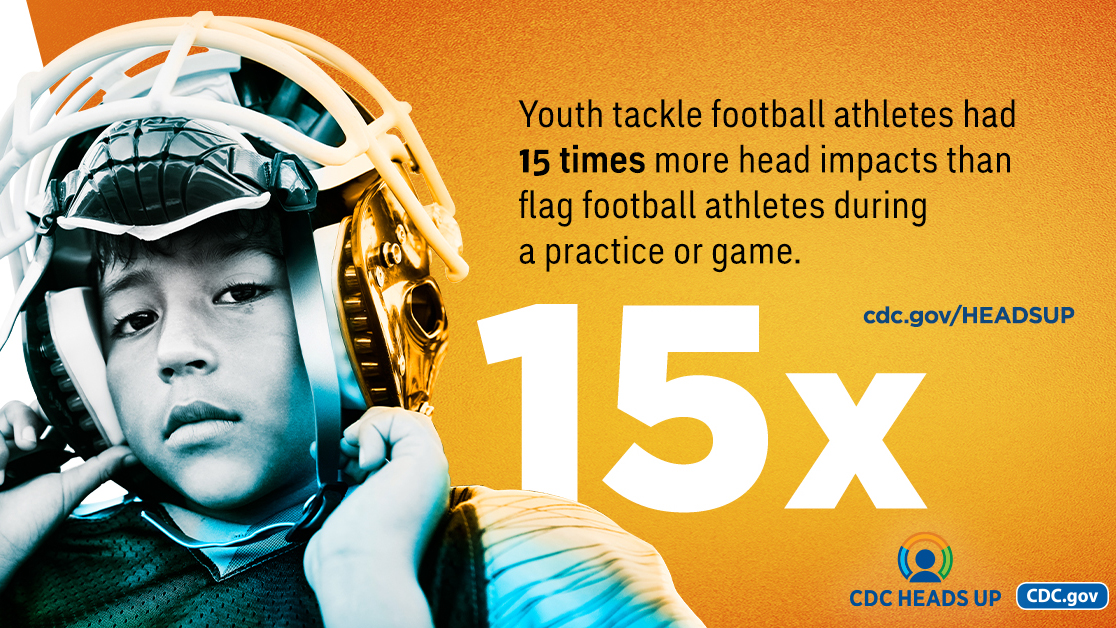
A CDC study published in Sports Health found that youth tackle football athletes ages 6 to 14 sustained 15 times more head impacts than flag football athletes during a practice or game. Tackle football athletes also sustained 23 times more high-magnitude head impacts (hard head impacts) than flag football athletes during a practice or game.
Head impacts increase the risk for concussion and other serious head injuries.
Key findings from the study include:
- Youth tackle football athletes experienced a median of 378 head impacts per athlete during the season.
- Flag football athletes experienced a median of 8 eight head impacts per athlete during the season.
These findings suggest that non-contact or flag football programs may be a safer alternative for reducing head impacts and concussion risk for youth football athletes under age 14.
More efforts needed to prevent head impacts during youth football games

A second CDC study published in The American Journal of Sports Medicine reports youth tackle and flag football athletes sustained two times more head impacts during a game than during a practice.
Key findings from the study include:
- Youth tackle football athletes had an estimated 18 times more head impacts per practice and 19 times more head impacts per game than flag football athletes.
- Youth tackle football athletes had an average rate of almost 7 head impacts during a practice and 13 impacts during a game, resulting in 2 times more ≥10g head impacts in games versus practices (g is a measurement of gravitational force equivalent).
- Youth flag football athletes had an average rate of 0.4 head impacts during a practice and 0.8 impacts during a game, resulting in 2 times more ≥10g head impacts in games versus practices.
- Youth tackle football athletes sustained 2 times more high magnitude head impacts (≥40g) in games vs practices.
These findings suggest a greater focus on game-based interventions, such as fair play interventions and strict officiating. In addition, the expansion of non-contact or flag football programs may be beneficial to reduce head impact exposures—especially for youth football athletes.
Five actions to lower head impacts in youth football

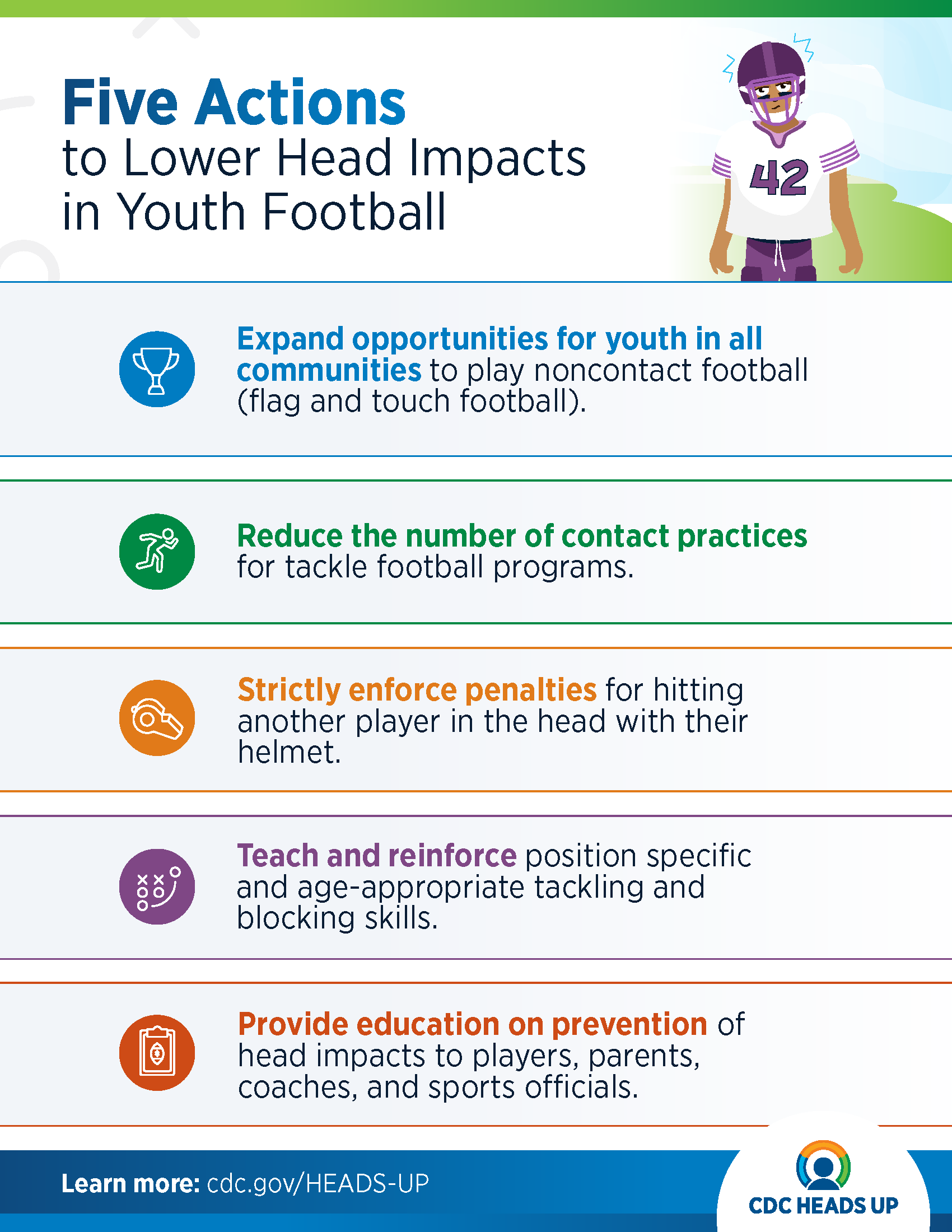
1. Expand opportunities for youth in all communities1 to participate in low-cost2 non-contact football programs, such as flag and touch football.
Why this is important: Non-contact football, like other sports, help youth build skills in athletics, leadership, and teamwork.3
2. Reduce the number of contact practices per week and the amount of time contact is allowed during a practice for tackle football programs.
Why this is important:
Head impacts during the high school football season dropped by 42% when a school reduced contact practices from 3 or more days to 2 or fewer days per week.4
3. Strictly enforce penalties for hitting another player in the head with their helmet, such as spearing or targeting for tackle football programs.
Why this is important:
Strict officiating and enforcing rules by coaches and athletes can decrease rates of injuries.5678
4. Teach and reinforce position-specific910 and age-appropriate tackling and blocking skills11 that avoid using the head to hit another player when contact drills are used during tackle football practice.
Why this is important:
Head impacts are more common among linemen12 and when players do high-speed,13 intensive14 and multiplayer tackle drills.1516
5. Provide education for players, parents, coaches, and sports officials on the:
- Dangers of head-first contact in football.
- Limits of protective equipment.
- Best techniques to avoid head impacts.
- Penalties for spearing, targeting, and hitting another player in the head.
- Importance of communication about brain safety between coaches, parents, athletes, and sports officials.
Why this is important: Training can improve identification and response to concussions and other head injuries.1718 Policies that require education combined with rule enforcement and contact practice restrictions may be most effective.19202122
Protecting players from head impacts lowers their chance for:
link